Bucharest, October 30, 2025 – Bucharest counts 718 pre-university educational institutions in 2025, according to an analysis conducted by Crosspoint Real Estate, International Associate of Savills in Romania, based on data from the Bucharest School Inspectorate. However, the distribution of educational capacity and the pace of school construction have failed to keep up with new residential developments.
Sector 1 has the most developed educational network (153 institutions) and the second-highest number of students and preschoolers (46,967), while the students-per-school ratio varies from 307 in S1 to 411 in S6. Across Europe, the optimal range is considered to be 250–400 students per school, while Romania’s average hovers around 440 students per school.
 “The private education network has expanded in parallel with the emergence of new residential neighborhoods, especially in the north, but remains limited in scale compared to the volume of new housing in peripheral areas, which continues to put pressure on public education supply”, said Ilinca Timofte, Head of Research at Crosspoint.
“Although there are areas where private institutions are gaining ground, more affordable neighborhoods such as Ferentari or Rahova remain underserved. In eastern Bucharest, the public school network still dominates, with potential for private development in line with residential growth”, she added.
Of all private educational institutions in Bucharest, 70% are kindergartens, while primary, middle and high school education remains predominantly public.
“Regardless of its expansion, private educational infrastructure cannot accommodate the large number of students aged between 6 and 18. New developments that have taken education into account generally included only kindergartens within residential projects, while the fundamental issue,distance from schools, has persisted”, noted Ilinca Timofte.
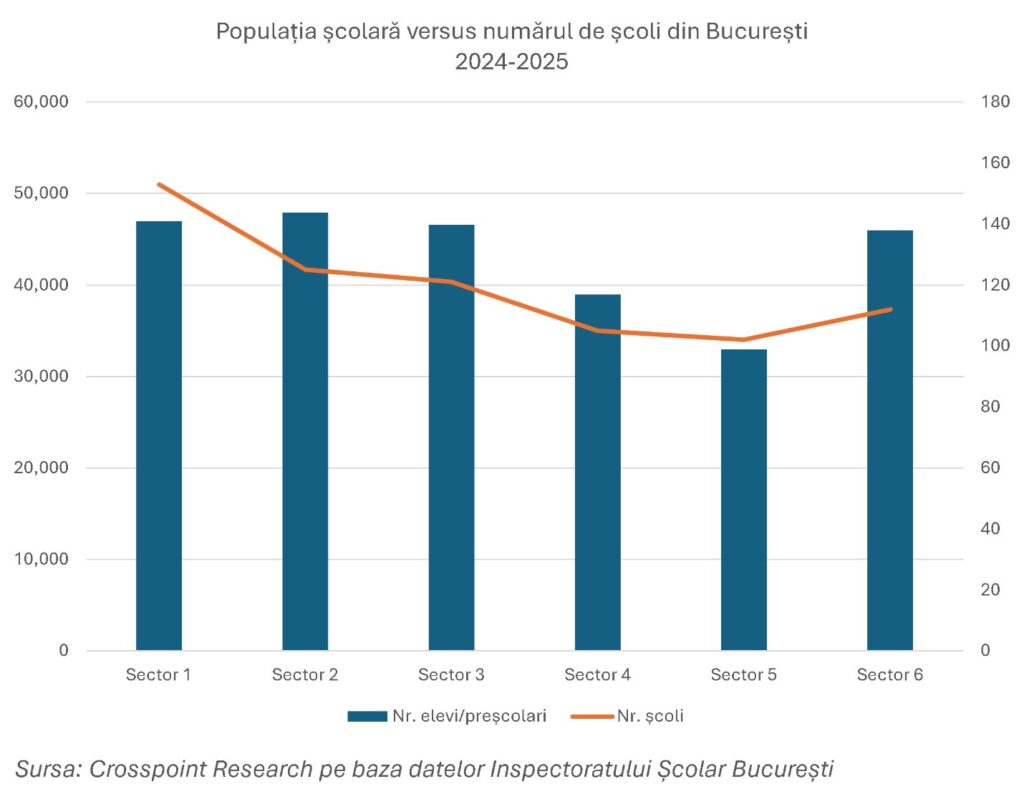
In recent years, residential growth has often progressed independently of educational and mobility infrastructure, and the effects are now visible in traffic congestion, time loss, overcrowded schools operating near maximum capacity and shifts in residential demand patterns.
“Proximity to schools, metro stations, parks and business hubs visibly drives price premiums, while three-room apartments remain the most sought-after option for families. About 20% of buyers are looking for four-room units, but most end up choosing three-room ones as the best balance between space, cost and maintenance”, explained Oana Popescu, Partner & Head of Residential at Crosspoint. “Some clients still prefer older apartments due to affordability and proximity to established schools. The absence of VAT on resale properties and functional layouts also support this segment. Our recommendation for new projects is to integrate educational components early and ensure strong connectivity to public transport, the areas where data shows a clear deficit”, Oana Popescu added.

Against this backdrop of sophisticated demand and uneven educational infrastructure, Crosspoint accelerated in 2025 its open-market residential division, focusing on individual transactions alongside exclusive project mandates. The firm’s recent portfolio includes projects like The Level Phase 1, Nusco City Phase 1, Quartier Azuga, Quartier du Nord, Novum, and Vulcan Residence.
Crosspoint’s open-market residential team currently includes nine consultants, with plans to expand to fully cover central and northern Bucharest. Sales and rentals in this segment exceed €15 million, with the average transaction value around €500,000. The company’s operational advantage stems from an integrated ecosystem of services, from land acquisition, feasibility and financial structuring to research, sales strategy, marketing and implementation, allowing residential products to align with real infrastructure needs, including education.